


Share this post
This is some text inside of a div block.
Copied!

Back to all posts
Practical advice and simple tools to help you settle in, learn quickly and set yourself up for success
.png)
Published on
February 18, 2026
Starting a new job is exciting, but it can also be a little unsettling.
You’re learning new systems, new people, new expectations and trying to figure out where you add value, all at the same time. It’s a lot. After placing thousands of professionals across Canada, we’ve seen a clear pattern: the first 90 days don’t determine whether someone is “good” at their job, but they do shape how confident, connected and supported they feel long term.
In this blog, we break down how to approach your first three months in a new role with intention, curiosity and a mindset that sets you up for success — without burning yourself out or trying to prove everything all at once.
Below, we’ll walk through what we’ve seen work well in real workplaces, plus practical tools you can use immediately.
The first few months in a role are less about performance and more about positioning.
This is the window where you start to understand how things actually work beyond the job description and onboarding documents. It’s when expectations begin to take shape, relationships start to form and you get a clearer sense of how decisions are made, who influences them and what success really looks like in this environment.
It’s also when habits are established. How you communicate, how you ask questions, how you manage your time and how comfortable you feel speaking up often take root early, sometimes without you realizing it.
That’s why the first 90 days can feel intense. There’s usually more observation happening than feedback, more learning than visible output and more internal pressure than anyone else can see. Many candidates we work with worry they’re not doing enough fast enough even when they’re right on track.
What we consistently see is that candidates who thrive long term are not the ones trying to “impress” immediately. They focus on listening and learning well, communicating clearly and building trust early. They ask thoughtful questions, share progress as they go and give themselves room to grow into the role instead of rushing to master it.
In other words, the goal of your first 90 days is not to have everything figured out. It’s to set a foundation that makes everything that follows easier.
The first month is all about understanding your new working environment: listening, observing, learning.
Instead of asking everything at once, space these out over your first few weeks:
Here’s a template you can adapt and use for email or chat:
Hi [Name],
I’ve just joined the team and am starting to get oriented, so I wanted to introduce myself. As I’m learning how different roles work together, I’d love to connect briefly to hear more about your work and where our paths might overlap. No rush at all.
Thanks,
[Your Name]
Create a simple list like this and update it as you go. It helps you be intentional about who you connect with and why, instead of relying on chance meetings or inbox pings.
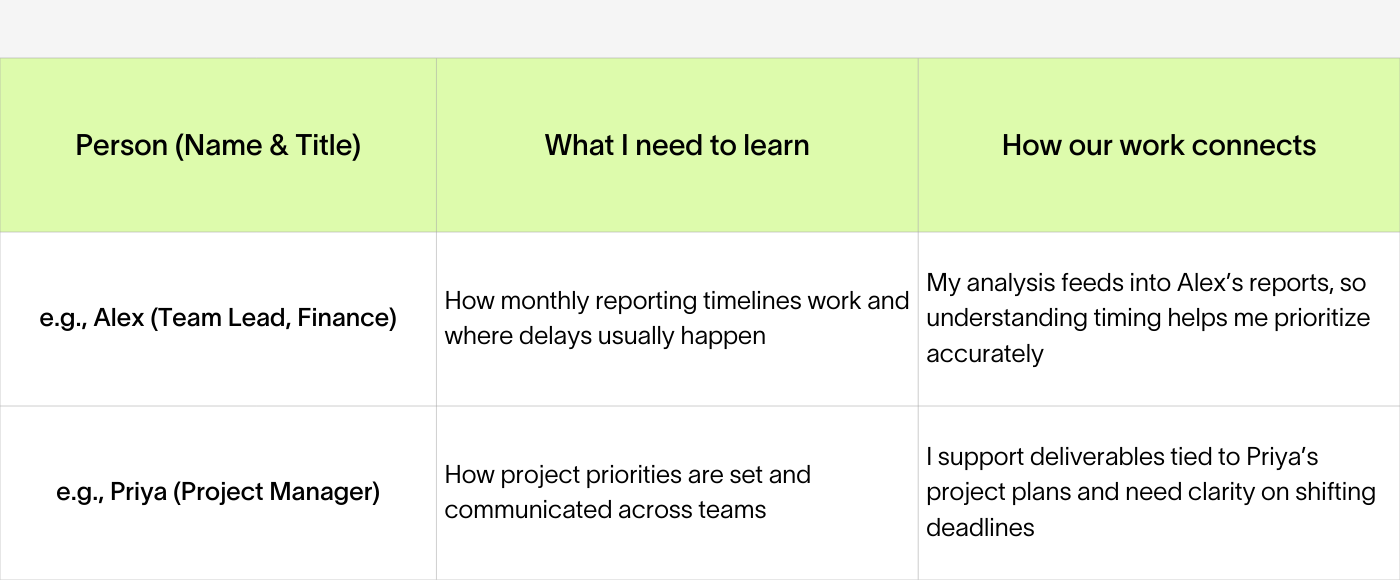
You don’t need to fill this out all at once. Add to it gradually as you learn more about the team and the broader organization.
By your second month, you’ll likely feel more grounded in the role. This is a great time to begin contributing more actively, without feeling like you need to have all the answers.
One pattern we see, especially in the first couple of months, is how easy it is to swing too far in one direction.
“A common challenge we see is new hires either staying too quiet out of fear of getting something wrong or overcorrecting by trying to change things too quickly. Both usually come from good intentions, but you want to land somewhere in between. The middle ground is regular communication and asking for context before taking action.” - Rory Colgan, Recruitment Partner
A more sustainable approach is micro-wins — small, visible progress that builds confidence and trust over time and helps others understand where you’re adding the most value.
Here are some examples of micro-wins:
If your manager doesn’t already have a structure, this weekly email template gives you a simple way to share progress and stay aligned. It helps you show momentum, make learning visible and invite guidance without feeling awkward or overly formal.
Hi [Manager’s Name],
I wanted to share a quick update on what I worked on this week, what I learned and a couple of questions I’m thinking through as I plan for next week.
What I worked on:
What I learned:
What I’m thinking about for next week:
Let me know if there’s anything you’d like me to adjust or focus on differently.
Thanks,
[Your Name]
Think of it as a low-key way to show what you’re getting done, what’s clicking and where a bit of direction would help.
Around the three-month mark, many people feel more confident and settled into their new role. This is the moment to step back and reflect, not just push forward.
Try writing a short summary for yourself:
This is incredibly useful for performance conversations and helps you articulate your value clearly, without sounding rehearsed.
“As I approach my first few months here, I’d love to check in on how things are going from your perspective and talk about priorities for the next phase. I’ve also reflected on what I’ve learned so far and where I’d like to continue growing.”
Work looks different than it did even a few years ago. Hybrid environments, leaner teams and constant change mean that success often comes down to communication, adaptability and clarity, not just output.
In hybrid or remote roles, this kind of intentional communication matters even more, since there are fewer casual moments to course-correct in real time.
The strongest candidates we see today:
You can use this as a quick self-check:
☐ I understand what success looks like in my role
☐ I’ve met key stakeholders
☐ I know how my team communicates and makes decisions
☐ I’ve taken ownership of specific work
☐ I’ve asked for feedback at least once
☐ I can clearly explain how my role supports the team
☐ I’ve reflected on my early impact
☐ I’ve had a forward-looking conversation with my manager
☐ I feel clearer about priorities for the next few months
Starting a new role is rarely about instant certainty. It’s about building momentum in small, steady ways and giving yourself the space to learn, adjust and grow.
The most successful transitions we see are shaped by consistent communication, thoughtful reflection and a willingness to ask questions along the way. When new hires feel grounded early, teams benefit too, with smoother collaboration, clearer expectations and fewer early resets.
If you’re in the middle of a transition or thinking ahead to your next move, remember that you don’t have to navigate it alone. Our recruiters work closely with candidates every day and share practical guidance, resources and webinars designed to support real career decisions, not just job searches.
Progress doesn’t always look loud or fast. Often, it looks like learning, showing up and building trust one week at a time.

Altis is a Canadian-owned staffing firm supporting organizations across the private and public sectors. We focus on relationship-driven recruitment, clear process and consistent delivery, helping employers hire with confidence and professionals build meaningful careers.


.png)